


Dr Claire Shovlin

Contact details

Dr Claire L Shovlin

Senior Lecturer in Respiratory Medicine
National Heart & Lung Institute

Email: Email address for Dr Claire L Shovlin

Dr Claire Shovlin

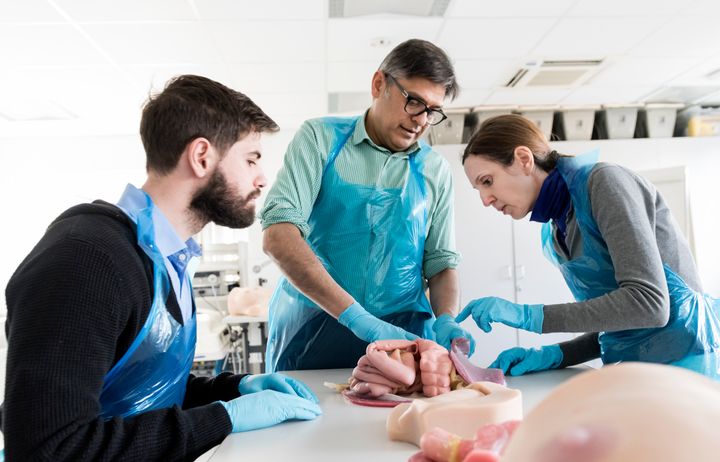
Dr Claire Shovlin is a Senior Lecturer in NHLI Cardiovascular Sciences, and Honorary Consultant in Respiratory Medicine for Imperial College Healthcare NHS Trust (Hammersmith Hospital campus). Dr Shovlin runs the Pulmonary Endothelial research group, is the co-ordinator for the respiratory module of the Imperial College MBBS Graduate Entry Programme (GEP), and as part of her clinical portfolio, runs a national clinic for people with hereditary haemorrhagic telangiectasia (HHT) and pulmonary arteriovenous malformations.  Her research programme incorporates reverse genetic and reverse translational approaches, predicted to dovetail into a single molecular cardiovascular programme.  

1) Research background:
Early research training
Dr Shovlin‘s early research training in the laboratories of Professors Sir Martin Evans (Cambridge 1984) and Michael Hayden (UBC, Vancouver, 1987), confirmed her medical school aspirations to study the genetic basis of human disease. While awaiting the outcome of her Wellcome Fellowship application to identify disease-causing genes for hereditary haemorrhagic telangiectasia (HHT), in 1992 she identified the novel disease of adult onset ADA deficiency in two respiratory clinic patients [1].  She identified their gene defects in Professor Anne Soutar’s laboratory at Hammersmith Hospital the following year [2].  Unusually for a rare genetic disease, treatment had been developed (for neonates, by the US Orphan Drug Program) but costs proved too expensive for the NHS. Dr Shovlin then spent three years of her PhD in Jon and Kricket Seidman’s laboratory in the Department of Genetics, Harvard Medical School, focussing on disease gene identification for HHT.

Concepts for translational approaches in a rare disease
By the time of her PhD completion in 1996, Dr Shovlin recognised that while disease gene identification was an essential component to the development of novel treatments, there were substantial temporal and financial obstacles to the development and delivery of molecular medicines, particularly for patients with a rare disease.  To develop a research programme more likely to deliver tangible health benefits to the generations under review, accessory approaches were considered. HHT is unusual in the degree of phenotypic diversity between relatives inheriting the same gene mutation. A generic model whereby inherited gene mutations raise the predisposition of a phenotype towards, but not necessarily to the measurable disease threshold was developed [3] This concept applies not only to the primary vascular dysplasia in HHT, but also to secondary complications likely to arise by perturbation of the same mechanisms as in the general population. 

2) Research Programme 1:   
Identification of disease genes for HHT:  Insights for vascular development, remodelling and disease            
Inherited as an autosomal dominant trait, HHT results in dilated fragile blood vessels which bleed, and arteriovenous malformations (AVMs). In early studies, the first HHT gene was mapped to chromosome 9 [4]; the endoglin gene was located within the interval by novel pPAC- and FISH-based techniques [5];  disease-causing mutations were identified, and the same mutation shown to result in non-penetrance, silent AVMs, or life-threatening complications [6]; and the molecular mechanism of HHT type 1 was defined as endoglin haploinsufficiency [6]. Four further HHT genes have since been identified.  Current work  funded by the British Heart Foundation, focusses on HHT3 on chromosome 5 [7], and highlights the importance of vascular bed-specific, dynamically regulated alternative splicing of gene transcripts. Third year PhD student Fatima Govani was awarded one of the July 2008 Imperial Graduate School of Life Sciences and Medicine prizes for work on coupling of endothelial cell alternative splicing and nonsense mediated decay related to this project [8].


 3) Research Programme 2: 
Reverse translational approaches in HHT     
In order to precision phenotype the HHT population to identify potential phenotypic modifiers, consensus diagnostic criteria [9] and appropriate selection of secondary outcomes [10] were required.  An initial approach to develop conditional transgenic models in collaboration with Professor John Mullins in Edinburgh was curtailed after successfully performing complex molecular work, including the use of homologous recombination in E Coli to generate targeted pPAC constructs. Instead, Dr Shovlin focussed on the human model of patients with HHT: having returned to the Hammersmith in 1999, she had initiated a three phase reverse translational approach:

  • Phase 1:  A prospective series to identify novel risk factors for clinical cardiovascular endpoints.  Simple power calculations and referral rates determined the series length of six years, with a seventh year for follow up before statistical interrogation in 2006-7. In total, 305 patients with HHT, 219 with PAVMs, were studied prospectively over six years. Novel statistical methods correlated 30 time-dependent patient variables with three outcomes selected due to likely inter-related pathophysiological mechanisms (see Phase 2 below), and two incorporated  for more immediate benefit of the HHT families whose donations were the sole source of funding for these studies.  Since November 2007, phase 1 data have been reported for all five endpoints studied [11-14].  For brain abscess [15] and  maternal complications during pregnancy [14], the data have already translated into altered patient management.
  • Phase 2: Exploration of potential endothelial and molecular mechanisms of newly identified risk factors for thromboembolic disease, pulmonary hypertension and paradoxical embolic stroke have led to a unified research theme focussing on alternative splicing within pulmonary endothelial cells.
  • Phase 3: Clinical studies in man are anticipated to commence in 2009.


References (full publication list attached)[1] Shovlin CL, Hughes JMB, Simmonds HA, Fairbanks L, Deacock SJ, Lechler RI, Roberts I, Webster ADB. Adult presentation of adenosine deaminase deficiency. Lancet 1993; 341: 1471[2] Shovlin CL, Simmonds HA, Fairbanks LD, Deacock SJ, Hughes JMB, Lechler RI, Webster ADB, Sun X-M, Webb JC, Soutar AK.  Adult onset immunodeficiency caused by inherited adenosine deaminase deficiency. J Immunol 1994; 153: 2331-2335.  [3]. Shovlin CL, Haslett C, Lamb J.  The Molecular and Cellular Basis of Disease. Davidson’s Principles and Practice of Medicine, 18th Edn, 1999: Churchill Livingstone, pp 1-56; 1128-3.  [4] Shovlin CL, Hughes JMB, Tuddenham EGD, Temperley I, Perembelon YFN, Scott J, Seidman CE, Seidman JG.  A gene for hereditary haemorrhagic telangiectasia maps to 9q3. Natur Genet 1994; 6: 205-209.  [5] Shovlin CL. Streamlined procedures for screening a P1 library.BioTechniques. 1996; 21: 188-190.  [6] Shovlin CL, Hughes JMB, Scott J, Seidman CE, Seidman JG.  Characterization of endoglin and identification of novel mutations in HHT.  Am J Hum Genet 1997; 61: 68-79.  [7] Cole SG, Begbie ME, Wallace GMF, Shovlin CL. A new locus for hereditary haemorrhagic telangiectasia (HHT3) maps to chromosome 5. J Med Genet, 2005. 42: 577-82.  [8] Govani FS,  Mollet IG, Jones MD, Shovlin CL.  Alternative splicing and nonsense mediated decay implicated in TGF-β1/BMP9 responses in endothelial cells. ICSLM 2008.[9] Shovlin CL, Guttmacher AE, Buscarini E, Faughnan M, Hyland R, Westermann CJJ, Kjeldsen A, Plauchu H.  Diagnostic criteria for Hereditary Haemorrhagic Telangiectasia.  Am J Med Genet 91:65-66, 2000.[10] Shovlin CL, Letarte M. Hereditary Haemorrhagic Telangiectasia and pulmonary AVMs.  Thorax, 1999.54: 714-729 [12] Shovlin CL, Sulaiman NL, Govani FS, Begbie ME. Elevated Factor VIII in hereditary haemorrhagic telangiectasia (HHT): association with venous thromboembolism. Thromb Haemost 2007 Nov;98(5):1031-9[11] Shovlin CL  Jackson JE, Bamford K, Jenkins IH, Benjamin A, Ramadan H, Kulinskaya E. Primary determinants of ischaemic stroke/brain abscess risks are independent of severity of pulmonary arteriovenous malformations in HHT.  Thorax 2008 Mar;63(3):259-66. [13] Shovlin CL, Tighe HC Davies RJ, Gibbs JSR, Jackson JE. Effect of embolization of pulmonary AVMs: No consistent effect on pulmonary artery pressure ERJ 2008 Jul;32(1):162-9[14] Shovlin CL, Sodhi V, McCarthy A, Lasjaunias P, Jackson JE, Sheppard MN. Estimates of maternal risks of pregnancy for women with hereditary haemorrhagic telangiectasia: suggested approach for obstetric services. BJOG 2008 Aug;115(9):1108-15. [15] Shovlin CL, Bamford KB, Wray D. Antibiotic prophylaxis prior to dental procedures for patients with pulmonary arteriovenous malformations (PAVMs) and hereditary haemorrhagic telangiectasia. British Dental Journal 2008 in press.


Selected Publications


Journals

  • Mason CG; Shovlin CL. (26 Sep 2011). Flight-related complications are infrequent in patients with hereditary haemorrhagic telangiectasia/pulmonary arteriovenous malformations, despite low oxygen saturations and anaemia. Thorax. DOI.
  • Shovlin CL. (Nov 2010). Hereditary haemorrhagic telangiectasia: pathophysiology, diagnosis and treatment. Blood Rev. 24:203-219. DOI.
  • Shovlin CL; Angus G; Manning RA; Okoli GN; Govani FS; Elderfield K; Birdsey GM; Mollet IG; et alLaffan MA; Mauri FA. (2010). Endothelial cell processing and alternatively spliced transcripts of factor VIII: potential implications for coagulation cascades and pulmonary hypertension. PLoS One. 5:e9154. DOI.
  • Shovlin CL; Sodhi V; McCarthy A; Lasjaunias P; Jackson JE; Sheppard MN. (Aug 2008). Estimates of maternal risks of pregnancy for women with hereditary haemorrhagic telangiectasia (Osler-Weber-Rendu syndrome): suggested approach for obstetric services. BJOG. 115:1108-1115. DOI.
  • Shovlin CL; Tighe HC; Davies RJ; Gibbs JSR; Jackson JE. (2008). Embolization of pulmonary AVMs: no consistent effect on pulmonary artery pressure. ERJ.
Share this on Delicious
Tweet this
Digg this
Stumble this
Share this on Facebook