Department of Medicine

Epstein-Barr Virus Laboratory

Group leader - Prof Paul Farrell

Epstein-Barr virus is a human herpesvirus that infects most people in the world early in life and then persists life-long. Primary EBV infection that is delayed until adolescence or adulthood frequently causes infectious mononucleosis (glandular fever). Most carriers of EBV show no symptoms or pathology but in some circumstances EBV is associated with human cancers, the virus normally being present in all of the tumour cells of an EBV associated case. These cancers include lymphomas in immunosuppressed people (either as a result of medication after transplant surgery or AIDS), Hodgkin's disease, Burkitt's lymphoma in central Africa, nasopharyngeal carcinoma in South-East Asia and some gastric carcinomas. EBV infects human B lymphocytes and certain epithelial cells; infection of lymphocytes is readily accomplished in the laboratory and EBV drives the cells into a state of permanent proliferation.

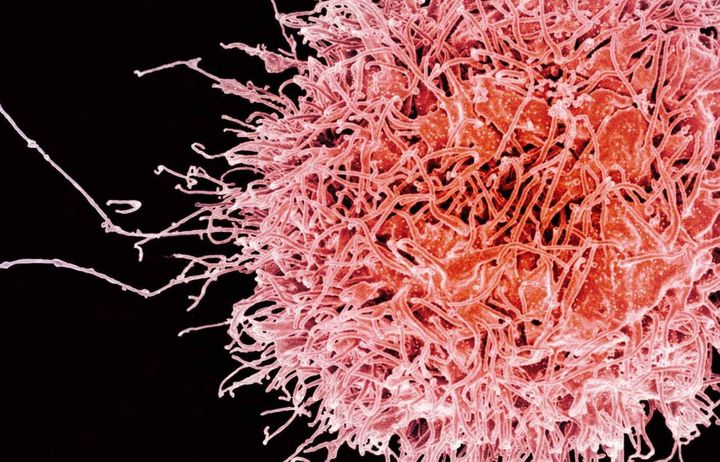
Normal human B lymphocytes proliferating in response to EBV infection - Professor Paul Farrell

Normal human B lymphocytes proliferating in response to EBV infection. The cells grow indefinitely in culture as a lymphoblastoid cell line.

We are studying the mechanisms by which EBV causes human cells to grow, the role of the virus in human cancers and the regulation of the switch between latent persistence and virus replication. The virus proteins EBNA-1, EBNA-2, EBNA-3A, EBNA-3C, EBNA-LP and LMP-1 are required for EBV to cause permanent growth of human B lymphocytes and expression of the virus protein BZLF1 is the key switch from latency to the replicative cycle.

Cell genes regulated by EBV - role of RUNX genes
EBNA-2 is an EBV transcription factor required for  cell proliferation observed in response to EBV infection. We used microarrays to  identify cell genes regulated by EBNA-2. One of these, RUNX3 (AML-2), is a member of the Runt domain family of transcription factors. Quiescent B cells express RUNX-1 but 48 hours after virus infection, levels of RUNX-1 decreased dramatically while the amount of RUNX-3 protein increased. Reduction of RUNX3 expression in LCLs  by RNAi slowed cell proliferation. We showed that the mutually exclusive expression of RUNX1 and RUNX3 is a consequence of cross regulation of the RUNX1 promoter by RUNX3. We are now investigating the role that RUNX proteins may play in the proliferation of B cells induced by EBV and  the mechanism by which RUNX1 prevents B cell proliferation.

The main natural variation that occurs in EBV strains is in EBNA2 and EBV strains are classified as type 1 or type 2 based on their EBNA2 sequence. Type 1 strains are much better at producing proliferating  human B cell lines upon infection than type 2 strains. We developed a new assay for EBNA2 in cell proliferation that distinguishes type 1 and type 2 EBNA2 and showed that a key functional difference lies in the C terminal part of EBNA2. We are currently mapping the important part of EBNA2 so that we can determine the mechanism of this natural functional difference in EBV types.

Reactivation of EBV from latency

 Induction of the BZLF1 gene is the first step in reactivation of EBV from latency. Using cloned Akata BL cells and oriP plasmids containing the BZLF1 gene, we accurately reconstituted the response of the BZLF1 gene to immunoglobulin crosslinking. Signal transduction responses to BCR cross linking on Akata cells are observed within 10 mins and the primary events in reactivation were shown to involve dephosphorylation of the MEF-2D transcription factor.  We are now studying additional factors that regulate the activation of the lytic cycle via Zp and the function of the BZLF1 protein.

The C terminal dimerisation domain of BZLF1 contains a coiled coil region similar to the leucine zipper present in many transcription factors but the extreme C terminus of BZLF1 folds back on to the outside of the zipper region making important stabilising contacts. We have shown that interaction of this C terminal tail with the zipper region is required for the DNA replication functions of BZLF1 but is unnecessary for its transcription activation function.

Functional RNAs expressed by Epstein-Barr virus
During latent infections, EBV expresses several types of non-coding small RNA that may have important functions but still allow the virus to evade immune surveillance since RNA is not detected by the adaptive immune response. Many EBV micro RNAs are produced in addition to the EBER RNAs.

The EBER RNAs (EBER1 and EBER2) are abundant RNAs about 170 nt long which are expressed in all latent EBV infections, including EBV associated cancers.  The mechanisms of action of the EBER RNAs are presently unclear and we are using EBV mutants to investigate this, hoping that they might provide targets for novel therapeutic approaches to treating EBV associated cancers.

Share this on Delicious
Tweet this
Digg this
Stumble this
Share this on Facebook