Faculty of Medicine

Back to Main News
ten birthday candles

Special events commemorate ten years of the Faculty of Medicine

25 September 2007

ten birthday candlesThe months from September to December are seeing double celebrations in the Faculty of Medicine, as we hold a series of special events to commemorate the ten-year anniversary of the formation of the Faculty, as well as Imperial College's Centenary.

St Mary's Hospital Medical School and the National Heart and Lung Institute merged with the College in 1988 and 1995, respectively. Charing Cross and Westminster Medical School and the Royal Postgraduate Medical School merged with the College on 1 August 1997 to form, with the existing departments on the St Mary's and Royal Brompton campuses, the Imperial College Faculty of Medicine.

A summary of upcoming events is below, and further details on locations and timings can be found on this page: www.imperial.ac.uk/medicine/news/p72108/


Charing Cross Campus

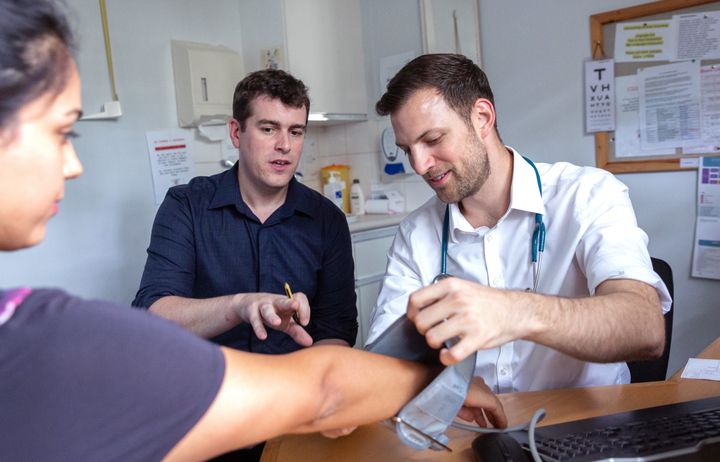
charing cross campusA display of the Faculty of Medicine's work will be on show at the Charing Cross campus until Friday 28 September, in the Charing Cross Hospital's first floor cafe. In addition, lunchtime visitors to the campus will be able to take part in interactive demonstrations by medical students and academics. Visitors can have their peak flow and blood pressure measured, have their body madd index calculated, and learn abuot stimulating the human brain.

Sixth form students with an interest in science will be coming to the Charing Cross campus from local schools on 25 September, to watch fun lectures about medicine and see demonstrations by some current Imperial medical students of the kinds of activities they undertake.

Professor Dame Nancy Rothwell, whose research has contributed towards major advances in understanding and treating brain damage in stroke and head injury, will be visiting the campus to deliver the Huxley Lecture on Thursday 27 September.

Dame Nancy, who is MRC Research Professor and Vice-President for Research at the University of Manchester, will be talking about problems with the central nervous system in her lecture "Flaming Brains - targeting inflammation in CNS disease and injury."


St Mary's Campus

st mary's campusThe programme of special events in Paddington began last week when Dr Michael Dunnill, Emeritus Fellow of Merton College Oxford, delivered a lecture on the life and work of bacteriologist and immunologist Almroth Wright. Almroth Wright started a research department at St Mary's Hospital in 1902. he is best know for his work advancing vaccination. Almroth Wright helped to develop a vaccine against typhoid and he convinced the armed forces to administer this to troops in World War One.

The historical theme continutes with this week's launch of a book of correspondence by medics from the St Mary's campus, written between 1897 and 1945. "Doctors at War" is a collection of letters written to the St Mary's Gazette during various conflicts, including the two World Wars, and discovered in the Medical School archives.

The cardiac theme continues in November with a lecture on the work of three St Mary's medics whose work has been influential in the field of cardiovascular disease, entitled, "Translating the Strategy of Prevention: the work of Geoffrey Rose, George Pickering, Stanley Peart and others in cardiovascular disease prevention." Imperial hypertension and cardiovascular expert Professor Neil Poulter will deliver the lecture on Thursday 8 November.

In December the history of heart surgery at St Mary's will be explored in a lecture entitled "50 years of Carotid Intervention at St Mary's" given by Visiting Professor of Vascular Surgery Nick Cheshire. In 1954, St Mary's surgeon Felix Eastcott performed one of the first ever thromboendarectomies - an operation to clear a blocked artery - when he cleared a blockage in the carotid artery in the heart.


South Kensington Campus

south kensington campusThe first of a series of events on the South Kensington Campus started last week when eminent surgeons gave keynote lectures about the surgical field at a Centenary Surgical Symposium. Professor of Surgery from the University of Toronto, Richard Reznick, Emeritus Professor of Surgery from Imperial College, Harold Ellis, and fellow Imperial Professor of Surgery Lord Ara Darzi were among the speakers on 20 September.

Professor Lord Robert Winston, fertility expert and famous face in the world of science communication, will give a booked-out prestigious lecture on 2 October entitled, "Manipulating the Human." Professor Winston's team have pioneers improvements in reproductive medicine subsequently adopted internationally, particularly in the fields of endocrinology, IVF and reproductive genetics. In addition, Professor Winston has presented numerous television programmes explaining the story of science and medicine to the public. After 2 October, this lecture will be available to download at www.imperial.ac.uk/aboutimperial/events/onlinelectures.

Professor of Biological Chemistry Jeremy Nicholson, will be leading a workshop on metabonomic medicine from 1 to 5 October, entitled, "Metabonomic and Metabolomic Tools in Integrative Systems Biology and Medicine." Metabonomics is emerging as a major interdisciplinary science. It involves measuring the dynamic metabolic response of living systems to different stimuli or genetic modification. It offers a way of identifying and indicating disease biomarkers and defining responses to therapeutic interventions.

One of the largest specialty meetings in neonatal medicine will be taking place at the College in November, with a 5-day international meeting entitled, "The Science of Newborn Care." Senior clinicians from around the world will meet to talk about new research and state-of-the-art clinical practice, from 26 to 30 November.


Royal Brompton Campus

brompton campusNobel Prize winner Professor Ferid Murad will be at the Royal Brompton campus on 25 September, presenting his lecture, "Discovery of NO and cyclic GMP and role in Drug Discovery and Development." Professor Murad is Director Emeritus of the Brown Foundation Institute of Molecular Medicine for the Prevention of Human Diseases and the John S Dunn Distinguished Chair in Physiology and Medicine. He is also a Professor in the Department of Integrative Biology and Pharmacology at the University of Texas at Houston Medical School. In 1998, he was a co-recipient of the Nobel Prize in Physiology or Medicine for his work with nitric oxide as a signalling molecule in the cardiovascular system.


Share this on Delicious
Tweet this
Digg this
Stumble this
Share this on Facebook